1905–1912
Eton blue
The first shirts were a paler Eton blue, taken from the racing colours of club president Earl Cadogan, worn with white shorts and dark blue or black socks.
Last updated:
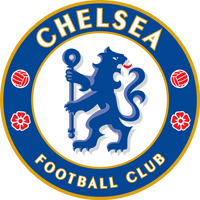
Chelsea have had four main crests, from a Chelsea Pensioner, the army veterans of the nearby Royal Hospital, to today's blue lion looking back over its shoulder holding a staff. The shirts have always been blue, and the blue shorts and white socks combination set by Tommy Docherty in the 1960s is still worn today.
Past crest images are not shown because they belong to their rights holders.
The first crest showed a Chelsea Pensioner, one of the army veterans living at the nearby Royal Hospital Chelsea, and gave the club its original "Pensioners" nickname. It lasted about half a century but never appeared on the shirts.
Source: Wikipedia
Ted Drake, appointed manager in 1952, thought the Pensioner crest old-fashioned and insisted it be replaced. A stop-gap badge of the initials C.F.C. was used for a year.
Source: Wikipedia
In 1953 the crest became an upright blue lion looking backwards and holding a staff. The lion came from the arms of club president Viscount Chelsea and the staff from the Abbots of Westminster, former Lords of the Manor. Three red roses for England and two footballs completed it, and in the early 1960s it became the first Chelsea crest worn on the shirts.
Source: Wikipedia
In 1975 the College of Arms granted a heraldic badge for Chelsea: the lion and staff within a blue ring, without lettering, roses or footballs.
Source: Wikipedia
In 1986, under owner Ken Bates, the club replaced the old lion, which could not be trademarked, with a naturalistic white lion standing over the C.F.C. initials. It lasted 19 years, appearing in red from 1987 to 1995 and yellow from 1995 to 1999 before white returned.
Source: Wikipedia
Under Roman Abramovich, with the centenary approaching and fans calling for the 1950s badge, the club returned to the blue lion and staff of 1953–86 from 2005–06. In the centenary season it carried the words "100 Years" and "Centenary 2005–2006".
Source: Wikipedia
Kit illustrations are FootRadars drawings based on the colours and patterns described in the sources, not the actual designs.
The first shirts were a paler Eton blue, taken from the racing colours of club president Earl Cadogan, worn with white shorts and dark blue or black socks.
Around 1912 the light blue gave way to royal blue shirts.
Tommy Docherty switched to blue shorts and white socks to make the kit modern and distinctive, first worn in 1964–65. Apart from 1985 to 1992, when blue socks returned, it has been the home kit ever since.
At Docherty's request, Chelsea wore blue and black stripes based on Inter Milan's kit in the 1966 FA Cup semi-final.
Away kits are usually all yellow or all white, with some exceptions: a red, white and green strip inspired by 1950s Hungary in the mid-1970s, jade in 1986–89, red and white diamonds in 1990–92, and the graphite and tangerine of 1994–96, which has appeared on lists of the worst kits ever.
Drawn from this season's kit colours in the club's English Wikipedia infobox. Patterns and details are only partly reflected.
Source: Wikipedia
| 1975–1981 | Umbro |
| 1981–1986 | Le Coq Sportif |
| 1986–1987 | The Chelsea Collection |
| 1995–2006 | Umbro |
| 2006–2017 | Adidas |
| 2017– | Nike |
| 1983–84 | Gulf Air |
| Dates not given in sources | Grange Farms |
| Dates not given in sources | Bai Lin Tea |
| Dates not given in sources | Simod |
| 1989– | Commodore (Amiga) |
| 1994–1997 | Coors |
| 1997–2001 | Autoglass |
| 2001–2005 | Emirates |
| 2005–2008 | Samsung Mobile |
| 2008–2015 | Samsung |
| 2015–2020 | Yokohama Tyres |
| 2020–2023 | Three |
| 2023–2024 | Infinite Athlete |
| 2025 | DAMAC Properties |
| 2026 | IFS |
| 2026– | Circle Internet Group |
This page was written with AI assistance from the sources listed below.